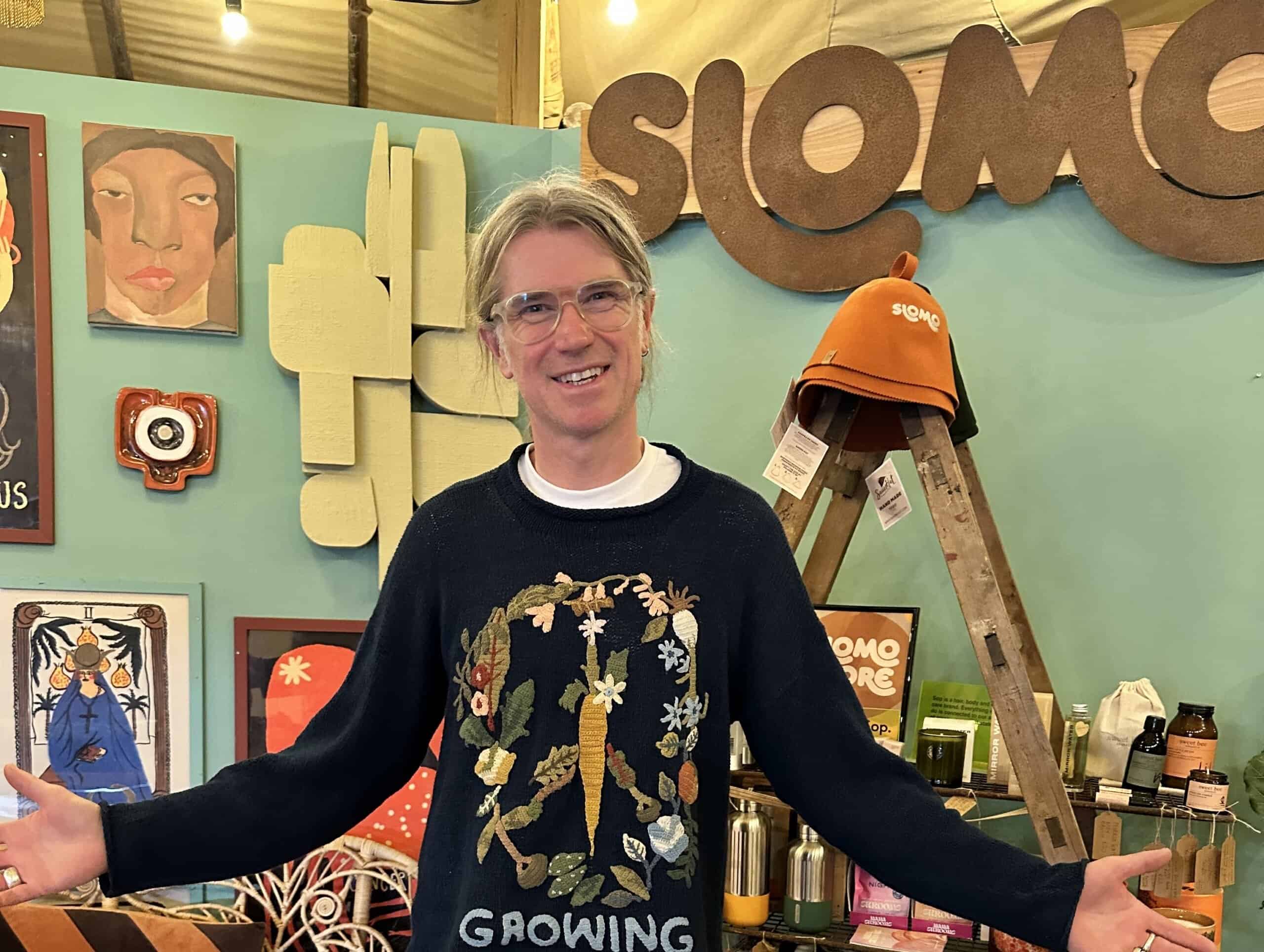
Lately, we’ve been thinking a lot about what it really means to slow down – especially in a world that rarely gives you permission to pause. That curiosity led us to a collaboration with Slomo, and it also felt like the perfect moment to sit down with Rob da Bank – Co-founder of Slomo Wellbeing, legend of Bestival & Camp Bestival, DJ & Meditation Teacher, and someone who’s spent decades balancing high-energy festival life with the need for stillness. Our conversation moved from burnout and boundaries to the role music has played throughout his life, and why learning to slow down has become one of the most important practices of all.
How are you, really?
Well, if this was anyone else asking, I’d probably say, fine, thanks, but seeing as it’s Self Space, I should think a little bit harder.
It’s been a very busy start to the year. My wife Josie and I have been absolutely full tilt with everything. We run music festivals as our livelihood, and we’ve been doing that for 20 plus years now. We’ve also got four kids, and we’re very hands-on parents, and we love doing that.
Then we have Slomo, which is a couple of years old and is on a crazy upward curve. This is fantastic, but it has its challenges. It’s testing our capabilities, but so far we’ve made it through.
You’ve spent over 20 years running Bestival and Camp Bestival, what has it taught you over the years?
In 22 years of doing anything there’s going to be so many highs and lows. Luckily, it’s mostly highs for us. Things like booking acts like Elton John, Stevie Wonder, Amy Winehouse, Snoop Dogg, Outkast, and Missy Elliott. I pretty much booked everyone I wanted to apart from Prince and Dolly Parton.
It was great to have acts like that perform, but the real magic has been in the escapism people find in what we do. This shows in Slomo as well. The world is challenging for everyone in so many ways. I think being able to escape into something supportive, even if it’s for an hour, is critical.
How did you get here?
I burnt myself out when I was 42. I was running music festivals, on Radio One, and doing all this stuff in my 20s and 30s. Then going into my 40s, I think my mind had just become full and I needed to slow down.
I got into cold water swimming a bit before lockdown, because we live near the sea on the Isle of Wight. I started looking at life in a different way, a bit less orientated towards late nights and partying.
The last 10 years have been a big exercise in slowing down. Ironically, I seem to be speeding up (like lots of us caught in the whirlwind of life), but I’m trying desperately to slow down or create moments to do so.
What is the Slomo approach to life?
Take life at your own speed. Everything at Slomo is here to help you do that.
I love combining the science of contrast therapy and hormesis – a beneficial stress for the body to help build resilience – with the feel good factor. I’m a meditation teacher and Josie is a yoga teacher, so we’ve brought in other practices alongside the sauna and cold plunge to help with this.
How do you look after yourself?
I meditate twice a day with my own practice, one that I also teach.
If I can, I get in cold water. And I do breathwork and my own kind of mindfulness during the day.
When you’ve got 3 or 4 kids to get to school it’s hard, so I try to get up early so I can fit some of that stuff in.
What song or album could you, like, not live without if you had to pick?
David Bowie, Hunky Dory. It was released in the year I was born. When I discovered it about age 15, my whole musical horizons opened up. I didn’t really know what I wanted to do when I was a kid and I think albums like that helped me towards music, for sure.
What are you comforted by?
Oh, that’s a good one. Um… my wife, my kids.
What is the kindest thing someone else has done for you?
Probably Josie for having four kids with me. Now that we’re through the baby years and I look back at it I realise Josie really did go the extra mile, taking the weight physically and emotionally.
I try to flip that around now.
If you could go back in time and meet 13-year-old-you and can only say five words to them, what would you say?
It will be okay, Robbie.
Who are you independent of your work identity?
A very small boy called Robert.
I think there is an identity out there, but the workaholic is created from a need to be noticed or valued.
Any final advice on getting through when things feel hard?
Try to surround yourself with positive people. Take some time every day to sit with yourself and get to know yourself. If you can, for just a moment a day, sit and feel how you’re feeling. The world isn’t suddenly going to get less evil from anyone meditating or spending time with themselves, but it will definitely make your journey a bit easier.